Tuesday, 8 March 2011

Religion

Like many other countries in the world, each region in India has it's own dialect, dress code, culture and tradition. Yet they all share the same social systems, grounded on religious beliefs. Indian Art has developed within Hindu, Jain and Buddhist traditions, which share similar symbols and motifs. The statistics below shows the percentage of believers for each religion. 


Based on the 2001 census

Art in ancient India was a hereditary profession. Artists began as apprentices. Apprentices learnt by following instructions in art texts know as Shilpa Shastras. These texts were a starting point, and insured that a constant aesthetic was maintained. Artists were treated as paid workers, and belonged to the lowest caste (the hierarchical system), but paradoxically, had privlidged access to wealthy and influential patrons including the royal family. This also meant that many artists were anonymous and the accolades went to the patron who initiated the project.

The patronage of art was often inspired by spiritual merit. Indian belief systems (Buddhist, Jain, Hindu and Sikh) believe that humans are too impure to achieve closeness to the divine ina single life-time, and that’s why they believe in Karma, which states that deeds performed in this lifetime determine your future birth.  Indians believed that one certain way of achieving good karma was to support the construction of religious monuments and art.

In Hinduism, there are four steps to achieving enlightenment:
Dharma (Virtue, Righteousness)
Artha (Wealth)
Kama (Love, Sex, Desire)
Moksha (Salvation, Liberation)


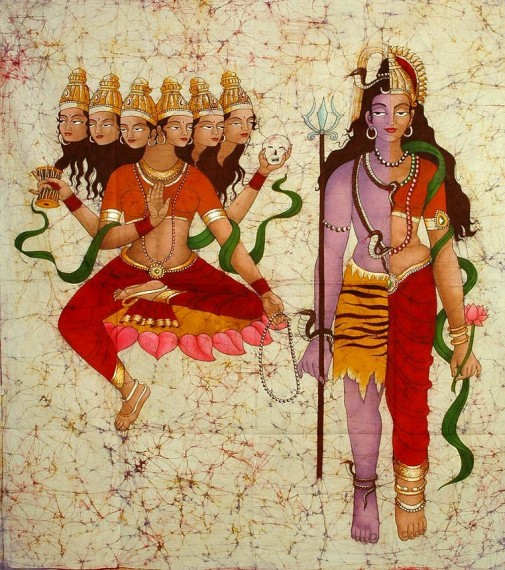
We can see from the images below, that all three religions place the emphasis on their philosophical and religious concepts through a complex language of symbols and motifs. This explains why, even on religious monuments, opulent gods, curvaceous/sensuous women, and the themes of wealth and sex are present. 


Buddhist Art


Hindu Art


Jain Art


Saturday, 5 March 2011

Statistics please :)

Hey Guys and Girls,
Could you pretty please with a cherry on top take a few minutes to fill out this questionnaire re. this project. I would very much appreciate it!!!!!!

http://www.stellarsurvey.com/s.aspx?u=C7E84B71-ED68-41DA-A37E-661324F5D1C2&
Thank you! 

Tuesday, 1 March 2011

Tutorial 1st March

Today we discussed how the project could be structured/approached, it was decided that this could happen in three phases:

Phase 1:
Research 
This is the pre-visit stage, consisting of researching and gaining knowledge about traditional techniques to be explored. Planning the visit i.e schedule in terms of which places need to be visited and how I will go about the trip and exploration. I will also conduct a series of “tests” (experiments) with what I have learnt thus far, in a foreign context.

Phase 2:
Learning
This is the visit stage, where I will be learning these techniques from local artists and artisans, creating a body of work in an authentic context, documenting the experience through photography, artworks, illustrations, sketches, experiments and a journal.

Phase 3:
Synthesis
This phase is in the final semester of my MA. Upon my return, the nature of work produced will be a “fusion” of old and new, the experiences and techniques learnt will influence a new approach to using traditional techniques in a modern context.

Monday, 28 February 2011

संक्षिप्त इतिहास

Indian Art had been in existence since the 3rd millennium BC. Indian art often seems overly ornate and sensuous. “Voluptuous feeling is unusually given free expression in Indian culture.” A strong sense of design is also characteristic of Indian art and can be observed in its modern as well as in its traditional forms. As mentioned in a previous post, majority of Indian art deals with the cultural history, religions and philosophies in a social context.

Indian art can be classified into specific periods each reflecting particular religious, political and cultural developments.

Ancient period (3500 BCE-1200 CE)
Islamic ascendancy (1192-1757)
Colonial period (1757–1947)
Independence and the postcolonial period (Post-1947) 


The earliest recorded art of India originated from a religious Hindu background, but when King Asoka (ca. 270-232 BCE) converted to Buddhism, Hindu themes started to be replaced by Buddhist art. Non-the less art in India has always been inspired by spiritualism and mystical relationships between man and god.

Water colors, charcoal and vegetable dyes were popular methods of painting. Fabric painting was also extensive. The purpose of art in ancient India was not just to adorn the walls, each painting had a story to narrate.

Visually ancient Indian art was colorful, aesthetic and appealing to naked eye, and unlike ancient western art, kings would commission the artists to paint from inspiration. The artwork of both Hinduism and Buddhism, depict scenes from mythological stories, which continue to inspire artists even now.

The range of techniques used in both ancient and modern art is vast. Here is a list of some that I could find: block priniting, blue pottery, embroidery, glass work, golden nakkashi, jewllery, leatherwork, metal work, jaipur miniature paintings, paper crafts, papier mache, terracotta, tribal arts, wall paintings, woodcarving, bandhani (tie dye), bead work, cane and bamboo work, carpet/dhurries, painting (various types), batik, pottery, textiles, weaving and appliqué work…

However, for the purpose of my project, I have chosen three techniques for further research and experimentation.

Leatherwork 


Painting (this includes batik) 


Woodcarving/block printing


Saturday, 26 February 2011

A disappearing act…

More than ever I have begun to realize how seemingly the traditions of many cultures are disappearing. Way of life including traditional clothing, beliefs, food, art, craft and culture in many countries are becoming more and more westernized.

More and more people appear to prefer western style weddings, wearing western style clothing, forgetting the celebrations of old traditions and customs, they are also becoming less interested in the many ancient skills and arts that history and tradition have to offer.

I’ve heard numerous friends and relatives complain that when they go on holiday, i.e. To Spain, it is just another England with better weather.

Throughout my travels I've noticed many people seem to think being western is ‘cool’. Globalization has propagated Western culture, on top of largely western government systems (democracy and constitution), many western technologies, customs, music, clothing, cars and art have been introduced across the world, they are then copied and re-created in non-western countries like Japan, India and China.

One of the main reasons for this overbearing influence of Western culture is due to our media, in particular Hollywood. In India for example Bollywood, been India’s equivalent, is seen to produce role models and the “ultimate image”, but how is Indian society meant to appreciate their traditions and culture when even Bollywood films have been influenced by Hollywood and America.

Of course the young want to challenge tradition, that is the same wherever you are in the world, but when Indian films portray a continuous trend of western aspects, of course India’s youth will be more inclined to western fashion, food, culture and way for life.

This is seen in the production of movies such as “Monsoon Wedding”. This movie represents the way Indian Culture is traveling. The influence that Hollywood has exerted on India can be seen clearly in this film.

“ The west has made it fashionable to wear jeans and tight fitting costumes and have western ideas such as sex before marriage.” 
A modern day Bollywood film poster

In the past Indian films have not portrayed any of these ideas and concepts. Indian Society has absorbed these concepts into their lives. This sort of Western influence is steadily creeping into Bollywood and through Bollywood into mainstream Indian culture.

Another factor in the disappearance of tradition is the pursuit of wealth. Many people migrate in the hope of better prospects. Immigrants can either radicalize in order to fit in or completely dissolve and assimilate into local culture. This is often the culprit behind the destruction of thousand-year-old culture and tradition.

Another major influence on the decline of tradition and culture is technology.

Today, communication can be made between two countries with no difficulty at all. The development in communication and technology has broken down barriers from the past, and because there are no longer any barriers between countries, the world has become a much smaller place. Technology has also replaced hobbies, customs and events that were normal in past years. For example, I was reading an article about Ramadan and how it has changed in Kuwait, one interviewee had this to say:

"Earlier, we did not have the technology that enables us to send a short message to congratulate relatives and friends on the coming of the month of Ramadan. But now, this is what prevents us from paying family and friends a visit, which used to have a special flavor, especially as they used to gather many relatives and friends under the same roof." 

Another Interviewee had a similar view on the influences of technology on tradition, saying that entertainment once used to be a communal thing were everyone would listen to traditional music, chat, tell riddles and play games, but now people would rather spend time watching television and using the internet.

"Neighbors used to exchange what they cooked every day, and this was called 'naksa'. Dishes used to go from house to house in the neighborhood throughout the holy month, and even on the feast day."

The Fat Duck

Heston Blumenthal is owner and chef of The Fat Duck, a three Michelin star restaurant that has been voted the best restaurant in the world. 


Heston is famous for his scientific approach and has been described as a culinary alchemist for his innovative style of cooking, although Heston himself describes his cooking as molecular gastronomy.

The reason I have chosen to discuss Heston and his cooking is because his themes and methods are similar to those I have chosen for my MA project. Heston's mantra is one of balance and contrast. All the dishes on the menu at The Fat Duck play with this balance of old and new, modern and historic. Heston is deeply interested in the history of British gastronomy and his menus reflects 2000years of culinary history though the exploration and reinterpretation of traditional British dishes.

During Edwardian times, with the presence of the British in India, curry became a well-loved English meal. An ice-cream pioneer Mrs. Marshall invented curried ice cream, which became a popular dessert at Edwardian dinners. In those days savory ice cream was rather common, however this is no longer the case. 


Mrs. Marshall

At one of his dinner parties, Heston captured this historic recipe with his curried ice balls. A dish inspired by Mrs. Marshall’s original recipe but he presented and modified the flavors in order to delight the modern palate. This is just one example of how Heston has taken traditional recipes and flavors and modernized them to make them more relevant and appreciated by the modern foody.


Wednesday, 23 February 2011

Tutorial 22nd Feb

In this tutorial, we each had to explain and answer one main question… What is the Project?

1. Modernizing Traditional art (techniques, methods and mediums) in order to provide greater appreciation, understanding and knowledge. The main goal of the project “a universal language” is to raise awareness

2. PD2, will focus on Indian Art traditions, techniques, methods, mediums and messages, creating and establishing a “system” or “format” that can be refined and extended for my Major MA project. 

3. By starting points 1 & 2 and through more research, I will consider an appropriate audience to whom the message will be aimed at. How the messaged will be communicated is also something to be considered throughout the process.

PD2 is about testing Ideas, and finding a way to balance tradition and modernization. “ It is not the solution, but the way forward”.

So… Here is what you can expect to be reading more about in the next week, a To Do list as such:

- Begin a broad research style into Indian Art, in order to gain a basic understanding of the culture and its traditions.

- Through Research, establish which areas I will focus on

- Find out why traditions vanish?

- Do some Research into events, organizations, exhibitions etc, that work could be attached to in order give the project strength, credibility and focus.